
FC Motagua Honduras Football: The Complete History of Ciclón Azul – From 1928 to Today
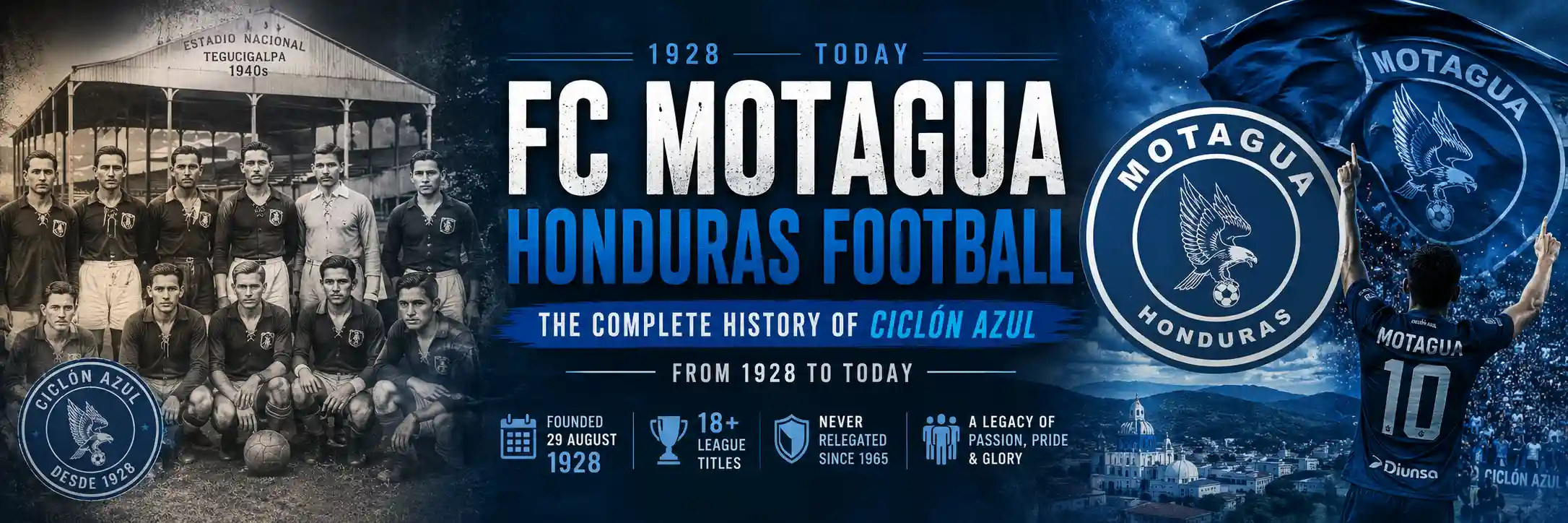
FC Motagua was born on 29 August 1928 through the union of three faltering clubs in Tegucigalpa – a founding story rooted in civic pride, national identity, and a river in dispute.
There are clubs that are built. And then there are clubs that emerge – forged by necessity, shaped by circumstance, and hardened by the particular pressures of a specific time and place. FC Motagua, the Tegucigalpa institution better known as Ciclón Azul, belongs firmly in the second category. Its birth in 1928 was not the product of wealthy patrons or calculated commercial ambition. It was an act of survival – and of vision. From that moment, Motagua would grow into the most passionate and historically significant football institution in the capital of Honduras, a club that has spent nearly a century accumulating trophies, traditions, and meaning.
The Founding: Three Clubs Become One
The story of FC Motagua begins in the final years of the 1920s, a time when football in Central America was still a grassroots affair, shaped more by neighbourhood rivalries and civic identity than by professional structures. In Tegucigalpa, three clubs – América, Honduras Atlética, and Águila – had each developed their own small followings and institutional identities. By 1928, however, all three were in decline. Diminishing memberships, financial difficulties, and organisational fragility threatened to leave the Honduran capital without a viable football club of any real substance.
It was in this context that two men – Marco Antonio Ponce and Marco Antonio Rosa – convened a critical meeting. Their proposal was bold but logical: instead of watching three clubs wither separately, the memberships should unite and form a single, stronger institution. The argument carried the day. In a decision that would shape Honduran football for generations, the three clubs agreed to merge. On 29 August 1928, Club Deportivo Motagua was officially founded.
The name chosen for the new club was deliberately symbolic. The Motagua River, which runs through Honduras and was at that time the subject of a territorial border dispute with Guatemala, represented something beyond geography – it stood for Honduran identity, sovereignty, and civic pride. To name the club after it was to declare an allegiance not just to football but to the nation itself. The eagle badge inherited from one of the founding clubs, CD Águila, completed the identity: a blue eagle, a contested river, a capital city’s football soul.
First Steps: From Neighbourhood Pitches to International Competition
The administrative work of founding a club was completed quickly. A board of directors was appointed, colours confirmed – dark blue, representing the deep waters of the Motagua River – and fixtures arranged. The club’s first competitive match was played on 25 November 1928, less than three months after the formal founding. The opponents were Tejeros del España, and the venue was La Isla in Tegucigalpa. The result of that inaugural encounter is lost to history, but the game itself marks the beginning of an unbroken competitive thread that runs to the present day.
For more than a decade, Motagua competed in amateur football across Tegucigalpa and the wider Honduran game, building their foundations and developing a culture. The club’s first international fixture arrived on 9 April 1939, when Motagua faced Costa Rican side Orión at the San Felipe field in Tegucigalpa. Under the management of Honduran coach Lurio Martínez, Motagua won the match 3-0, with all three goals scored by striker “Gorgojo” Ramos. It was a statement of early ambition and the first indication that the club was thinking beyond the borders of its own city.
Throughout the 1940s and 1950s, Motagua continued to grow. Football in Honduras was expanding rapidly during this period – new clubs were forming across the country, stadiums were being built, and the organizational framework of the national game was beginning to take shape. The National Autonomous Federation of Football of Honduras, FENAFUTH, had been founded in 1935 and affiliated to FIFA in 1946. By 1964, the Liga Nacional de Fútbol Profesional de Honduras – LINAFUTH – was established, and the first professional season began in 1965.
The Professional Era Begins: The 1965-66 Season
When the Liga Nacional was inaugurated on 18 July 1965, FC Motagua were among the founding participants. From that day to the present, Motagua have never been relegated from the top division – a record of sustained presence that only a tiny number of clubs across the country can claim. This fact alone speaks to the institutional strength of the organisation, the consistency of its management, and the depth of its connection to the city of Tegucigalpa.
The club’s adjustment to the professional era was swift. Playing in a competitive division that included clubs from across Honduras, Motagua quickly established themselves as one of the most capable outfits in the league. It took just three years for the first professional championship to arrive. Under the management of Rodolfo Godoy, the 1968-69 season produced a title-winning campaign that went down in club history. Motagua finished with 39 points, edging out two-time defending champions Olimpia, who ended on 36. The margin was clear, the achievement undeniable: this was a proper, dominant championship performance.
What made the 1968-69 season even more historically resonant was the additional achievement of winning the inaugural Honduran Cup. The domestic double – league and cup in the same season – was completed in Motagua’s third professional campaign and established a precedent for ambition that has defined the club’s approach ever since.
The Golden Seventies: Titles, World Cup, and Rival Dominance
The seasons that followed the first title set the tone for a golden period. In 1970-71, Motagua claimed their second Liga Nacional championship in a particularly dramatic fashion. After the full season’s fixtures, Motagua and Olimpia finished exactly level on points – a genuine tie at the top of the table. With no playoff mechanism in place under the regulations of the time, the title was decided by goal difference alone. Motagua prevailed by the narrowest of margins, hoisting the championship trophy in circumstances that underlined just how closely matched – and passionately contested – the rivalry between the two Tegucigalpa giants had already become.
The 1970s continued in productive fashion. Motagua added Liga Nacional titles in 1973-74 and 1978-79, while consistently finishing as runners-up or within the top tier of the table in the years between those victories. The quality of the squad during this decade was reflected in the composition of the Honduras national team. When Honduras qualified for the FIFA World Cup for the first time in their history – the 1982 tournament in Spain – five of the squad’s players were drawn from Motagua’s ranks. That statistic is a remarkable testament to the club’s ability to develop and sustain talent at the highest level. Players like Ramón Maradiaga and José Roberto Figueroa, both of whom would represent their country in Spain, were key contributors to this era of Motagua dominance.
The Difficult Decade: The 1980s Drought
The relative success of the 1970s gave way to a challenging decade in the 1980s. Between 1979 and 1992, Motagua failed to win a single Liga Nacional title – a period of 13 years that represented the longest championship drought in the club’s professional history. The reasons were multiple: rival clubs invested, improved, and introduced new tactical systems; Motagua’s squad cycles were not always synchronised with title-winning form; and the broader landscape of Honduran football became increasingly competitive.
But the 1980s were not without meaning or significance. The club maintained its Liga Nacional status throughout, never dipping below the top division. It continued to attract and develop players. The support base in Tegucigalpa – and particularly the emerging supporter culture that would eventually crystallise into the barra brava “Los Revolucionarios del Motagua 1928” – remained loyal and vocal. Motagua’s identity during this period was tested but not broken.
The Return to Glory: 1992 and Beyond
When the end of the drought finally came in the 1991-92 season, it came with force. Motagua claimed the Liga Nacional title by defeating Real España 1-0 in the championship playoffs – a narrow but decisive result that ended a 13-year wait and reopened the floodgates of success. The relief in Tegucigalpa was palpable. The club had not forgotten how to win; it had simply been waiting for the pieces to fall back into place.
What followed was a period of renewed and sustained dominance. The 1990s saw Motagua add Honduran Cup victories in 1993 and 1995, then produce one of their most spectacular title runs when the Apertura and Clausura format was introduced. In the 1998 Apertura, Motagua beat Real España 5-2 on aggregate in the championship final – a crushing victory that demonstrated clinical finishing and collective quality. Incredibly, they repeated as champions just months later in the 1997-98 Clausura, defeating Olimpia 1-0 to claim back-to-back titles. This double triumph in a single split-season was one of the most impressive sequences of results in the club’s professional history.
The momentum continued into the 2000s. Motagua won the 1999-2000 Apertura and Clausura – another remarkable double – and followed that with the 2001-02 Apertura title, cementing their status as the dominant force in Honduran football at the turn of the millennium. During this period, the club participated regularly in CONCACAF club competition, gaining continental experience and exposure that further developed their players and coaching staff.
The 2007 Continental Triumph
If there is a single moment that stands apart from all others in the modern era of Motagua’s history, it is the 2007 UNCAF Interclub Cup triumph. Managed by Ramón Maradiaga – himself a legendary player for the club and national team – Motagua reached the final of the Central American interclub competition and faced Deportivo Saprissa of Costa Rica, one of the most decorated and feared clubs in the region.
The first leg, played in Costa Rica, ended 1-1. The second leg was held on 12 May 2007 at Estadio Nacional in Tegucigalpa, in front of a passionate home crowd. Brazilian import Josimar Nascimento scored the only goal of the match, giving Motagua a 2-1 aggregate victory and delivering the club its first – and to date, only – international title. The scale of the achievement cannot be overstated. Saprissa had three CONCACAF Champions’ Cup titles to their name. Defeating them in a continental final, in a performance built on tactical discipline and collective belief, was the defining result of Maradiaga’s managerial tenure and a landmark in Honduran football history.
Modern Era: Diego Vásquez and the 2010s-2020s
The decade following the 2007 triumph saw Motagua continue to add Liga Nacional titles, with championships in 2010-11, 2014-15, 2016-17, 2018-19, 2021-22, and the 2024-25 Apertura. A crucial figure in the club’s modern success has been manager Diego Vásquez, who took charge of the first team in 2013 and became the longest-tenured coach in the history of the Honduran top flight, overseeing more than 200 consecutive matches. Vásquez left in 2022 to manage the Honduras national team, but returned to Motagua in 2023 – a homecoming that underlined just how deeply his identity had become intertwined with that of the club.
Throughout this period, Motagua also continued to produce and attract players of real quality. Emilio Izaguirre, who began his career at Motagua before becoming a Celtic and Honduras legend, returned to the club in his later career. International forwards, Brazilian and Uruguayan imports, and highly capable Honduran midfielders have all cycled through the blue shirt, maintaining the club’s competitive edge season after season.
By 2026, FC Motagua hold 19 Liga Nacional titles – more than any club in Honduras save for arch-rivals Olimpia – plus four domestic cup victories and one international trophy. They have participated in CONCACAF club competition 19 times and have never been relegated from the top division since its inception in 1965. The club’s 34-player squad, its loyal fanbase across Honduras, its iconic dark blue colours, and its eagle badge all speak to an institution that has shaped the sporting and cultural life of Tegucigalpa for nearly a century.
The Motagua story is not one of easy triumph. It is a story of founding vision, patient construction, crisis and recovery, and a deeply held conviction that the blue of the Motagua River is worth fighting for. It is, above all else, the story of Honduras football.

FAQ – FC Motagua Honduras Football History
FC Motagua was officially founded on 29 August 1928 in Tegucigalpa, Honduras, through the merger of three declining clubs – América, Honduras Atlética, and Águila. The initiative was led by Marco Antonio Ponce and Marco Antonio Rosa, who proposed the union as the only viable path to creating a sustainable football institution in the capital. The club was named after the Motagua River, which was at the time a point of territorial dispute between Honduras and Guatemala, giving the name strong national symbolic significance.
FC Motagua have won 19 Liga Nacional titles across their professional history. Their first professional championship came in the 1968-69 season, just three years after the top division was inaugurated in 1965. That season, under manager Rodolfo Godoy, Motagua finished with 39 points to edged out two-time defending champions Olimpia. They also won the inaugural Honduran Cup that same season, completing a historic double in the club’s third professional campaign.
FC Motagua’s greatest international achievement is the 2007 UNCAF Interclub Cup, which they won by defeating Costa Rica’s Deportivo Saprissa 2-1 on aggregate in the final. The decisive second-leg goal at Estadio Nacional in Tegucigalpa was scored by Brazilian forward Josimar Nascimento. This remains the only international title in the club’s history and the only occasion a Honduran club has beaten Saprissa in a continental final. Manager Ramón Maradiaga, himself a legendary Motagua player and World Cup representative, led the team to this triumph.